


Why your shoulder pain is really a message from your whole body
By Dr. Ronel Corbin
Table of Contents
What Is Frozen Shoulder, Really?
Frozen shoulder, also known as adhesive capsulitis, is a condition where the connective tissue surrounding your shoulder joint becomes inflamed, thickened, and stiff. This leads to chronic pain and loss of mobility—often without any clear injury.
“A condition of uncertain etiology, characterized by significant restriction of both active and passive shoulder motion that occurs in the absence of a known intrinsic shoulder disorder.” (Pubmed)
In simple terms: your body forms scar-like tissue around the joint, gradually locking it in place. It’s a “slow freeze”—and it’s frustratingly common, especially for women in midlife.
Visual Comparison: Normal vs. Frozen Shoulder
To better understand what’s happening inside the joint, here’s a visual comparison of a healthy shoulder versus one with frozen shoulder.

Why Is It Called ‘Frozen Shoulder’?
Despite the name, your shoulder doesn’t feel cold. The term “frozen shoulder” was coined in 1934 by Dr. E.A. Codman, who observed patients gradually losing mobility—as though the shoulder were freezing up.
Before that, in 1872, the condition was described as periarthritis scapulohumeral—an older term for inflammation around the joint.
Everyday Movements That Become Impossible
Frozen shoulder makes life frustrating. These simple movements suddenly require effort—or are out of reach altogether. Everyday actions become painful or impossible:
- Putting on a bra or jacket
- Reaching for your seatbelt
- Sleeping on your side
- Washing your hair
- Loading the washing machine
- Driving or steering
- Hugging your loved ones
Why Is It So Mysterious?
The mystery of frozen shoulder lies in the fact that it often develops without any injury. One day your shoulder starts hurting, and over time, it stiffens until movement becomes nearly impossible.
Emerging research suggests it may be an autoimmune or inflammatory reaction, where the body mistakenly begins attacking the shoulder capsule. The tissue becomes thick, fibrotic, and inflamed—restricting motion and causing pain.
A 2024 study even suggests that immune system dysregulation could play a role in frozen shoulder development.
A Whole-Body Problem, Not Just a Shoulder Issue
Here’s the big truth most people miss:
Frozen shoulder is often a sign of systemic inflammation and imbalance—not just a local joint problem.
It is commonly linked to:
- Autoimmune conditions
- Diabetes
- Thyroid dysfunction
- Menopausal hormone shifts
- Previous chest or breast surgery
Physical therapy helps—but PT alone often isn’t enough, because it doesn’t address the underlying cause.
That’s why so many physical therapists refer their patients to me. When we work together—combining movement and whole-body healing—the results are significantly better.
Why Women Over 50 Are Especially at Risk
Women in perimenopause and menopause are at significantly higher risk for frozen shoulder. Here’s why:
- Estrogen drops, reducing tissue repair and increasing inflammation
- Collagen production decreases, making ligaments and tendons stiffer
- Sleep issues, chronic stress, and blood sugar problems reduce the body’s healing ability and drive up systemic inflammation.
- Autoimmune risk increases in midlife
A 2023 study from Duke Orthopaedics linked estrogen decline and more inflammation to increased rates of frozen shoulder.
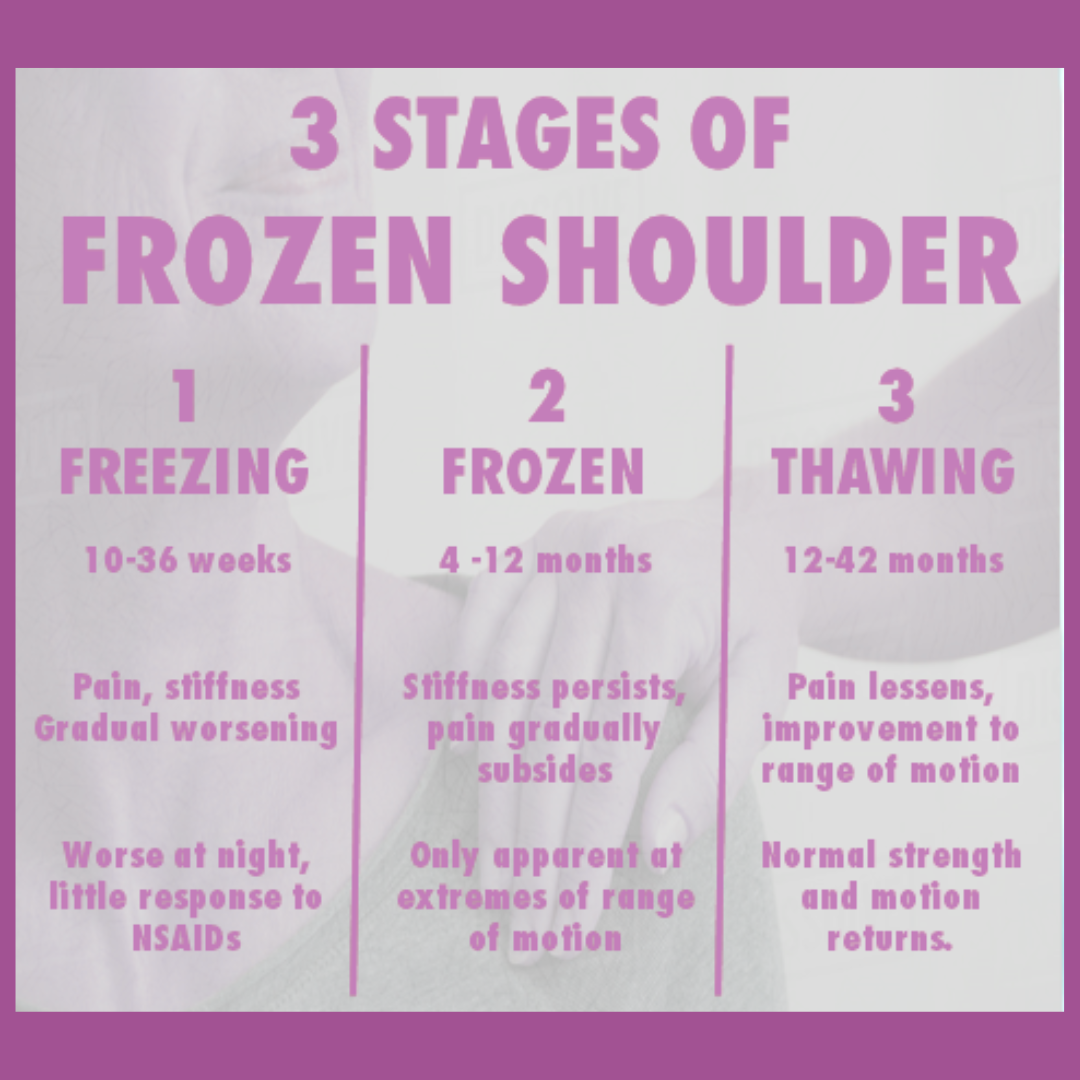
The 3 Stages of Frozen Shoulder
Stage 1. Freezing Phase (2–9 months)
- Increasing pain, especially at night
- Gradual loss of motion
- Difficulty with daily tasks
Stage 2. Frozen Phase (4–12 months)
- Pain may plateau or slightly improve
- Movement becomes severely limited
- Shoulder feels stiff and locked
Stage 3. Thawing Phase (5–24 months)
- Range of motion begins to return
- Strength and function gradually improve
- Healing accelerates with the right treatment
Source: Singapore Medical Journal via PubMed
What Does Chinese Medicine Say?
In Traditional Chinese Medicine (TCM), frozen shoulder is called “Fifty Year old Shoulder”, as it commonly affects people around age 50.
It is believed to stem from:
- Blood and oxygen (Qi) deficiency
- Stagnation in the meridians
- Cold-Damp invasion blocking circulation to the shoulder
In modern terms: circulation is stagnant, cellular mitochondrial energy is poor, and inflammation has pooled in the shoulder.
Acupuncture, herbal formulas, cupping, and food therapy can restore balance and support healing. And the results are backed by research.
A clinical study showed that combining acupuncture plus physical therapy led to a 76.4% improvement, versus only 39.8% with PT alone.
Could It Be Your Shoulder… or Your Hormones?
If you’re a woman over 40 with shoulder pain, this may be more about your hormones, immune system, and inflammation than your joint itself.
That’s why I don’t just treat the shoulder. I treat the whole woman—because frozen shoulder is often a symptom, not the root problem.
What’s Next?
In Part 2, I’ll guide you through how I help women heal frozen shoulder using:
- Acupuncture & Chinese medicine
- Anti-inflammatory foods & herbs
- Smart, gentle movement strategies
- Infrared light therapy
- Personalized lifestyle medicine
No cortisone. No endless physio. No surgery as a first option. Just smart, root-cause healing.
📍 Stay tuned for Part 2: “How Frozen Shoulder Can Be Cured Naturally.”
💬 Got Questions?
I’d love to hear from you.
- 💻 Connect with me at HealingElephant.com
- 🌿 Join our private Facebook group for women over 40 navigating hormonal health and healing.
